It has been over a year since I started doing Olympic Fencing in addition to my HEMA studies and now, a year on, I feel I can talk about what it has done to help me improve and what the 2 styles have taught me that each alone would not.
For years I was one of THOSE guys. Talking trash about Olympic fencing, calling it tag with Car antennas, throwing things out about it not being remotely real and so flawed and only a game that it could not be redeemed. Then a dear friend of mine said she was taking it and so I thought, what the heck.
Walking into the community ed class that night I was one of those students that teachers hate. The kind who walk into something with arguments against anything that may be brought up, ready to push my own buttons and prove somehow I was better. The second the instructor mentioned that fencing was an art, and evolved out of brutish and uncivilized swordplay, the second they talked about how the rapier was the pinnacle of the evolution of the sword and as such superior to the Long sword, I was ready to strike. To jump up, and prove that he was wrong, and everything he taught may be questionable. That opportunity never came.
What he did explain on that first night was how I had been thinking about swords for a long time. Weapons changed over time, a rapier was not better than a Long sword but it was all dependent on your purpose. Each had it's advantages and disadvantages but his art was not better than mine, it was just different. We did lunges, he asked me if I had done sword lunges before. We learned some basics, much of which I had been doing for so long that it was easy to feel at home doing them. Things like basic defensive blocks and strikes were all things that I recognized from years of doing "My" sword technique. I expected a fight, what I found was something much better.
A year on, and I am helping coach Olympic fencing when I come to class. I work on helping others learn basics, and stick to the theory that good fencing is good fencing. Yes you can teach someone to play the game, teach them that a parry that does not actually take your opponents point offline but is considered by a director as a parry can be counted in the game setting, but I try not to teach bad habits like that. The rules are different, so are the weapons, so are a few of the techniques, but at the end of the day I can say in all honesty that I have improved as a swordsman because of things I have learned and worked with in my Olympic fencing class. My feet move faster, I am no longer stuck in the same spot in a ring but can move much more quickly around my opponents (A big accomplishment for a big dude like me).
I learned to play their game, but the beautiful thing is that they had no pretenses that it was not one. I have begun to see that my major practice and focus was in many ways also playing a game as much as I had fought for years that it was different. Not better, or worse, just different. They use linear footwork, I use circular, (depending on where I am) but quickness in my feet translates to both. The leg muscles I build in HEMA translate to Fencing. Moving my body forward by moving my legs and not leaning into the fight means that I am moving like I should. HEMA or Olympic, I am moving like a fencer.
I am not the best Olympic Fencer. Hell, I am not even incredibly great. but I am OK and in taking the time to learn and help others I am finding out things about myself I did not know before, and bring that to both playing fields.
At the end of the day what it all boils down to is as long as I am willing to look at what other things have to show me, I can improve. But the minute that I allow myself to think that my way is the only right way, I miss out on the lessons that someone else can teach me. 2 paths, not entirely separate from each other, each having something to bring to the conversation. Is one better than the other? I still prefer Long Sword, but that does not make it better, just different. Either way doing both has helped me learn that though if I had to choose I know where I would end up, that does not mean that something else does not have something to teach me that I missed in my own practice. I still bring things to my HEMA teacher that he laughs at me and says "Jordan, I have been trying to teach you that for years!" Maybe I am a slow learner, but as long as I am willing to learn, I can only improve and that is what really matters.
Wednesday, May 6, 2015
Tuesday, March 24, 2015
What am I willing to do to get there?
I have been thinking quite a bit about about goals lately. Both for myself, for helping others, and in general and have come to an interesting conclusion. Goals become a question of them being attainable, and what are you willing to do to get there?
Every year my Sword group holds 2 group competitions. They are a fun time and definitely something I enjoy doing. Here is the thing, as much as I feel like I am pretty good, and should place in the top half of the class, I don't always do so.
Why not?
I train as often as other people in class, I always intend to work outside of class, why am I not doing better?
You want to know a secret?
Plainly put I don't want it bad enough. (Man, that sucks to say out loud.)
I am realizing something. It does not matter how bad I want it. It does not matter if I spend everyday thinking about it and hoping that somehow I will get better. If I am not willing to put some skin in the game, I wont get there. I can let my limitations keep me where I am and be mad that I am not getting better, or I can decide to do something about it and get there.
There is good news and bad news in this. The good news is that if I am willing to put time into it, I will improve. The bad news is if I am not willing to do anything differently but complain about how bad it sucks that I can't do anything about it, it ought to fall of deaf ears. If I am not willing to put the time and effort in it, should I be surprised when the results are exactly the same? Nope.
So where do we go from here?
Goals are great, they give us something to shoot for. In that I have 2 choices. Do something to get there, figure out my priorities and do it, OR change the goal to something that meets what I am willing to give up. That is it.
Mad that I am not placing high in competition?
I can either train harder than the next guy and work to improve, or I can be ok with where I am and realize that I will get better but not at a rate that I want to. That is it. Those are the 2 options period.
2 years ago I was mad that I could not make it to any events within the HEMA community. It really sucks when some things are really expensive and your income is limited. Using this model I had 2 options. Shut up and work for it, or continue to complain but realize that complaining was getting me no closer to the goal. Within that spectrum, there are some choices. In this case I went to something that was as close to me as I could find. This year it may be 2 or 3 that are closer, Maybe even do something here. But I have no room to complain when I am not willing to work for it.
Here is another example from my Heavy Athletics experience. I am not a good thrower. The first year I went to practices, and did try to go to events. I wanted to get better, but to be perfectly honest, I was not willing to put the time in to improve. As a result other people moved ahead of me, Other people who were brand new moved ahead of me, I was not willing to put in the time and effort to get there so I shouldn't have been surprised when my results were consistent but showed no real marked changes. I could be mad about it, I could be frustrated, but the point is if I am not willing to do things to get where I say I want to go, it should be no surprise if I do not get there.
Priorities. The name of the game is making priorities and following through.
With throwing it comes down to this: I was not willing to go to every event that I could because I had things that held a higher priority. I skipped a throwing practice to be at sword because I had a sword event coming up. I skipped events because I had other things going on that were more important to me that I attend, or sometimes, a different role at the same one. Was it any surprise that I did not just magically get better? It shouldn't be.
I will be honest. I will support anyone that has goals if they are willing to do what it will take to get there. In my fencing class every week I give the students homework, 3 minute drills on nothing but footwork. Every week, I ask them who did their homework, sometimes I see new hands, other weeks it is the same people saying they did it. Of course, they all could lie and say they did it, but what I am find interesting is that the people who tell me they are doing it, don't even have to tell me anymore, I can see it in how they are improving.
Is it OK not to drop everything to reach that goal? Sure it is. This year I am cutting back how many Highland Games events I am going to be participating in because there are other things that fall higher on my list. That is OK the key is to not get mad when I am not improving as much as those who are training more. Do I expect to get first place at everything I do when I am not willing to put the time in to improve? If I do, I am setting myself up for failure.
Some people may have natural talents but the point is what am I willing to do to keep up with them? Is it a night to watch TV then complain that I only trained 2 days this week instead of 3? It is my choice. If my goal is really to get better, that means that despite wanting to watch my show on TV tonight I may have to give it up since my goal places higher on my priority list.
At the end of the day it comes down to this.
If I want to get better, I am going to have to put the time in to get there. If not, it is time to realize that it is OK if I am not willing to put in the time, just as long as I realize that progress may not be as quick as it would if I were willing to do so. I can miss a lot of parties, or spend a lot of evenings alone if my only goal is to get better with a sword in my hand, the key is to decide what matters, and to be OK letting everything else go, knowing that in doing it, I am choosing just how quickly or easily I reach my goals. There is no right or wrong speed, I may never reach it if I am not willing to put the time into it. But I am always at choice about the results, I can be mad for not doing anything to get better and then work to improve, or I can be OK with what I am doing and realize that I will not win Gold in the Olympics fencing if I am not willing to put some time into working to get there.
It is all my choice, but I do not get to whine about the results of those choices anymore.
Every year my Sword group holds 2 group competitions. They are a fun time and definitely something I enjoy doing. Here is the thing, as much as I feel like I am pretty good, and should place in the top half of the class, I don't always do so.
Why not?
I train as often as other people in class, I always intend to work outside of class, why am I not doing better?
You want to know a secret?
Plainly put I don't want it bad enough. (Man, that sucks to say out loud.)
I am realizing something. It does not matter how bad I want it. It does not matter if I spend everyday thinking about it and hoping that somehow I will get better. If I am not willing to put some skin in the game, I wont get there. I can let my limitations keep me where I am and be mad that I am not getting better, or I can decide to do something about it and get there.
There is good news and bad news in this. The good news is that if I am willing to put time into it, I will improve. The bad news is if I am not willing to do anything differently but complain about how bad it sucks that I can't do anything about it, it ought to fall of deaf ears. If I am not willing to put the time and effort in it, should I be surprised when the results are exactly the same? Nope.
So where do we go from here?
Goals are great, they give us something to shoot for. In that I have 2 choices. Do something to get there, figure out my priorities and do it, OR change the goal to something that meets what I am willing to give up. That is it.
Mad that I am not placing high in competition?
I can either train harder than the next guy and work to improve, or I can be ok with where I am and realize that I will get better but not at a rate that I want to. That is it. Those are the 2 options period.
2 years ago I was mad that I could not make it to any events within the HEMA community. It really sucks when some things are really expensive and your income is limited. Using this model I had 2 options. Shut up and work for it, or continue to complain but realize that complaining was getting me no closer to the goal. Within that spectrum, there are some choices. In this case I went to something that was as close to me as I could find. This year it may be 2 or 3 that are closer, Maybe even do something here. But I have no room to complain when I am not willing to work for it.
Here is another example from my Heavy Athletics experience. I am not a good thrower. The first year I went to practices, and did try to go to events. I wanted to get better, but to be perfectly honest, I was not willing to put the time in to improve. As a result other people moved ahead of me, Other people who were brand new moved ahead of me, I was not willing to put in the time and effort to get there so I shouldn't have been surprised when my results were consistent but showed no real marked changes. I could be mad about it, I could be frustrated, but the point is if I am not willing to do things to get where I say I want to go, it should be no surprise if I do not get there.
Priorities. The name of the game is making priorities and following through.
With throwing it comes down to this: I was not willing to go to every event that I could because I had things that held a higher priority. I skipped a throwing practice to be at sword because I had a sword event coming up. I skipped events because I had other things going on that were more important to me that I attend, or sometimes, a different role at the same one. Was it any surprise that I did not just magically get better? It shouldn't be.
I will be honest. I will support anyone that has goals if they are willing to do what it will take to get there. In my fencing class every week I give the students homework, 3 minute drills on nothing but footwork. Every week, I ask them who did their homework, sometimes I see new hands, other weeks it is the same people saying they did it. Of course, they all could lie and say they did it, but what I am find interesting is that the people who tell me they are doing it, don't even have to tell me anymore, I can see it in how they are improving.
Is it OK not to drop everything to reach that goal? Sure it is. This year I am cutting back how many Highland Games events I am going to be participating in because there are other things that fall higher on my list. That is OK the key is to not get mad when I am not improving as much as those who are training more. Do I expect to get first place at everything I do when I am not willing to put the time in to improve? If I do, I am setting myself up for failure.
Some people may have natural talents but the point is what am I willing to do to keep up with them? Is it a night to watch TV then complain that I only trained 2 days this week instead of 3? It is my choice. If my goal is really to get better, that means that despite wanting to watch my show on TV tonight I may have to give it up since my goal places higher on my priority list.
At the end of the day it comes down to this.
If I want to get better, I am going to have to put the time in to get there. If not, it is time to realize that it is OK if I am not willing to put in the time, just as long as I realize that progress may not be as quick as it would if I were willing to do so. I can miss a lot of parties, or spend a lot of evenings alone if my only goal is to get better with a sword in my hand, the key is to decide what matters, and to be OK letting everything else go, knowing that in doing it, I am choosing just how quickly or easily I reach my goals. There is no right or wrong speed, I may never reach it if I am not willing to put the time into it. But I am always at choice about the results, I can be mad for not doing anything to get better and then work to improve, or I can be OK with what I am doing and realize that I will not win Gold in the Olympics fencing if I am not willing to put some time into working to get there.
It is all my choice, but I do not get to whine about the results of those choices anymore.

Wednesday, February 11, 2015
Teaching
The last 2 months I feel like I am a changed man. Between beginning my 30 for 30 challenge, then keeping it going for the last 10 days I am learning a lot and learning little things I can do better. My weight has flexed but not broken where I want it to, but I am working towards my goals and it feels good.
In January I started helping coach my Olympic Fencing class. The experience has been awesome and I am learning quite a bit in trying to learn things to help them with. It is like I may actually get better at this stuff yet. Some of it is learning how to play the game, but to me the key is to teach good technique regardless of the game. In HEMA that means working to avoid the double hit or the after blow, In Olympic Fencing it is about teaching technique that supersedes right of way and is a clear strike with a block or block with at strike so it is clear no matter who has right of way, that you won the good touch.
Also in January I taught a couple of classes on my own in my Long Sword group. This was mostly our instructor being gone, so I filled in. Saturday was different. Last week my instructor decided to let me teach so he could observe. To me, and from the feedback I got it went well. We had a larger group than usual, and they all seemed to like the format of the class I used, as well as liking some of the drills I came up with to go over things with them.
A lot of this has gotten me thinking, am I ready to teach?
In the past I have helped teach, I have taught on weeks someone was not there, or gone up and worked with my study group. But am I, right now, ready to teach? If tomorrow I was told I could by my instructor, would I be ready. Last week I am not sure I would have been. Too much self doubt, too much worrying about how I would do it, too much worrying that I would not have anything good to bring to the table.
That was then, this is now.
I realized something last week that really helped me. It is OK to say I do not know. It is OK to teach and not have all the answers. Sometimes the answers that are best come from discourse with the students and coming to better answers than I would alone. To assume that a single instructor has all the answers, and any other possibility is wrong makes for bad teaching and is the start to me of dying arts. What matters to me is being flexible enough to consider other possibilities. But it also comes down to relying on what I know enough to trust.
The big thing for me is getting over the self doubt, getting over the self esteem stuff and know that yes, I do know my stuff. I do not have all the answers, but that gives me room to grow. Can I get better? To think otherwise is a futile idea. But the key in my mind is how do I carry myself. Will I allow that self loathing and doubt to rule me, or will I trust that I have studied a long time, have room to improve and could get there with a little work for my own, and my students good.
You cannot move forward without some sort of idea of what moving forward looks like. This is mine. I feel like I am ready, and will continue to learn, not just for myself but for my students. A couple of weeks ago I started a drill with the fencers. It was a simple drill that came out of seeing a need and working to fix it. So what does a good teacher do? If I do not honestly know the answers, go looking for them, or perhaps send the student asking to search for them. This makes me push myself, and at the same time, push others towards their greatness too, and at the end of the day, that is what matters to me. Not glory, not pride, but helping others succeed. Do I get something out of it? It feels good when I do it so yes. To me though that is one of the greatest gifts I can receive and it is a gift that I give myself.
In January I started helping coach my Olympic Fencing class. The experience has been awesome and I am learning quite a bit in trying to learn things to help them with. It is like I may actually get better at this stuff yet. Some of it is learning how to play the game, but to me the key is to teach good technique regardless of the game. In HEMA that means working to avoid the double hit or the after blow, In Olympic Fencing it is about teaching technique that supersedes right of way and is a clear strike with a block or block with at strike so it is clear no matter who has right of way, that you won the good touch.
Also in January I taught a couple of classes on my own in my Long Sword group. This was mostly our instructor being gone, so I filled in. Saturday was different. Last week my instructor decided to let me teach so he could observe. To me, and from the feedback I got it went well. We had a larger group than usual, and they all seemed to like the format of the class I used, as well as liking some of the drills I came up with to go over things with them.
A lot of this has gotten me thinking, am I ready to teach?
In the past I have helped teach, I have taught on weeks someone was not there, or gone up and worked with my study group. But am I, right now, ready to teach? If tomorrow I was told I could by my instructor, would I be ready. Last week I am not sure I would have been. Too much self doubt, too much worrying about how I would do it, too much worrying that I would not have anything good to bring to the table.
That was then, this is now.
I realized something last week that really helped me. It is OK to say I do not know. It is OK to teach and not have all the answers. Sometimes the answers that are best come from discourse with the students and coming to better answers than I would alone. To assume that a single instructor has all the answers, and any other possibility is wrong makes for bad teaching and is the start to me of dying arts. What matters to me is being flexible enough to consider other possibilities. But it also comes down to relying on what I know enough to trust.
The big thing for me is getting over the self doubt, getting over the self esteem stuff and know that yes, I do know my stuff. I do not have all the answers, but that gives me room to grow. Can I get better? To think otherwise is a futile idea. But the key in my mind is how do I carry myself. Will I allow that self loathing and doubt to rule me, or will I trust that I have studied a long time, have room to improve and could get there with a little work for my own, and my students good.
You cannot move forward without some sort of idea of what moving forward looks like. This is mine. I feel like I am ready, and will continue to learn, not just for myself but for my students. A couple of weeks ago I started a drill with the fencers. It was a simple drill that came out of seeing a need and working to fix it. So what does a good teacher do? If I do not honestly know the answers, go looking for them, or perhaps send the student asking to search for them. This makes me push myself, and at the same time, push others towards their greatness too, and at the end of the day, that is what matters to me. Not glory, not pride, but helping others succeed. Do I get something out of it? It feels good when I do it so yes. To me though that is one of the greatest gifts I can receive and it is a gift that I give myself.
Thursday, January 29, 2015
Sword for everyone!
I love practicing the Historical European Martial Arts. Anyone who knows me knows that.
There is a lot of commotion in the community from time to time about women in HEMA and I just wanted to make my point clear. Everyone is more than welcome but encouraged to come and practice with me in the arts I love to practice.
I want to encourage men, women, anyone who wants to come to learn how to use a sword to come to one of the classes I am a part of. That is just how I am, I love it, and if I think for a moment that anyone else I know would love it too, I would rather they come and learn with me, then to not come and participate. There is a unfortunate lack of women in class, I am not sure what that is about, but we do not have as many women in our class as there are men. This is not unique, I am sure there is something cultural about it, but what I do know is that I am not a fan of it.
You see the thing is that the more people we have in class the better we can become. The more different styles and personalities we face week to week, the better we learn what works with what and how to counter things better. It is easy when you only spar with the same half a dozen people every week to know their tricks and how to beat them, New and different people make you learn how to do it better, and sometimes see where your weak points are.
Women add to that.
In class in years past we have taught a one size fits all strategy for all things the truth is this never works. What happens if your arms are not as long as your opponents, or you stand a full head shorter than they do, or what if you have a harder time moving a sword from one place to another because your chest gets in the way? Ultimately facing these challenges forces us to work with them to come up with different solutions and think about the art differently. Maybe you cannot effectively go over the arms for a hip throw but can by going under the arms, is it better to learn a way that does work for you then only have the answers that do not? To me it does.
People are not cookie cutters. There are some people in my class that are just quicker than I am, but if I do not train with them, how can I learn to counter it, or to make myself better? Diversity breeds innovation. I am a larger guy who is not always as quick as my opponents, so I have learned to be faster on my feet so I can be. (Ever see a 300 pound dude hopping at you with a sword? Fun times.) I have reach on a lot of people, but if I do not think about how to counter that, I cannot ever be a good teacher of the art I love.
There is also a fine line here between adjusting to meet the needs, and allowing excuses. Allowing excuses happens when we are doing a drill and someone just does not want to do it because they think that they cant. Excuses happen when there is mental block that says "I can't fence this person because they are better than me, they have been fencing longer, and they have more skill than I do." Allowing excuses is not helpful, in fact I think it lets people get off the hook when just trying and pushing through is the better lesson than giving up and going home.
If you are fast but can't fight strength than work on strength and until it is there use what comes natural to you.. If you can't swing a sword the right way because your chest gets in the way, lets work on ways to counter that, make it work. If you are a full head shorter than your opponent and we are doing grappling, lets look at what you can do and teach you both the proper way, as well as something that you CAN do so you are not in a bad position when you need to use the technique. If it means Womens tournaments because that is how you get people involved, then that seems like a great way to get people involved.
Fencing is about balance. Balancing pushing peoples perceived limitations, and giving them a hand to help them up. Encouraging without babying. Teaching, but sometimes stepping back to see the student step up and teach themselves. (Often the lessons that stick come from this.) Sometimes the balance is literal: right and left, or front and back. But unless we are putting our hands out there to encourage people to join and try it out, we can't hope to get better. Unless we are friendly to everyone, no matter the age or gender, we will not be as good as we hope to be.
Our diversity makes us better, both as students as well as teachers. The better you know how to deal with a difficult student the better chance you have to keep them, and maybe pass on those same skills to someone else. If we do not embrace that diversity we become foolish, like the person who "knows everything already" and as such is not open to new ideas or new ways of looking at the same thing.
Our diversity makes us strong, if this sounds like something you want to try out let me know, in the mean time I am here, doing my daily practice.
There is a lot of commotion in the community from time to time about women in HEMA and I just wanted to make my point clear. Everyone is more than welcome but encouraged to come and practice with me in the arts I love to practice.
I want to encourage men, women, anyone who wants to come to learn how to use a sword to come to one of the classes I am a part of. That is just how I am, I love it, and if I think for a moment that anyone else I know would love it too, I would rather they come and learn with me, then to not come and participate. There is a unfortunate lack of women in class, I am not sure what that is about, but we do not have as many women in our class as there are men. This is not unique, I am sure there is something cultural about it, but what I do know is that I am not a fan of it.
You see the thing is that the more people we have in class the better we can become. The more different styles and personalities we face week to week, the better we learn what works with what and how to counter things better. It is easy when you only spar with the same half a dozen people every week to know their tricks and how to beat them, New and different people make you learn how to do it better, and sometimes see where your weak points are.
Women add to that.
In class in years past we have taught a one size fits all strategy for all things the truth is this never works. What happens if your arms are not as long as your opponents, or you stand a full head shorter than they do, or what if you have a harder time moving a sword from one place to another because your chest gets in the way? Ultimately facing these challenges forces us to work with them to come up with different solutions and think about the art differently. Maybe you cannot effectively go over the arms for a hip throw but can by going under the arms, is it better to learn a way that does work for you then only have the answers that do not? To me it does.
People are not cookie cutters. There are some people in my class that are just quicker than I am, but if I do not train with them, how can I learn to counter it, or to make myself better? Diversity breeds innovation. I am a larger guy who is not always as quick as my opponents, so I have learned to be faster on my feet so I can be. (Ever see a 300 pound dude hopping at you with a sword? Fun times.) I have reach on a lot of people, but if I do not think about how to counter that, I cannot ever be a good teacher of the art I love.
There is also a fine line here between adjusting to meet the needs, and allowing excuses. Allowing excuses happens when we are doing a drill and someone just does not want to do it because they think that they cant. Excuses happen when there is mental block that says "I can't fence this person because they are better than me, they have been fencing longer, and they have more skill than I do." Allowing excuses is not helpful, in fact I think it lets people get off the hook when just trying and pushing through is the better lesson than giving up and going home.
If you are fast but can't fight strength than work on strength and until it is there use what comes natural to you.. If you can't swing a sword the right way because your chest gets in the way, lets work on ways to counter that, make it work. If you are a full head shorter than your opponent and we are doing grappling, lets look at what you can do and teach you both the proper way, as well as something that you CAN do so you are not in a bad position when you need to use the technique. If it means Womens tournaments because that is how you get people involved, then that seems like a great way to get people involved.
Fencing is about balance. Balancing pushing peoples perceived limitations, and giving them a hand to help them up. Encouraging without babying. Teaching, but sometimes stepping back to see the student step up and teach themselves. (Often the lessons that stick come from this.) Sometimes the balance is literal: right and left, or front and back. But unless we are putting our hands out there to encourage people to join and try it out, we can't hope to get better. Unless we are friendly to everyone, no matter the age or gender, we will not be as good as we hope to be.
Our diversity makes us better, both as students as well as teachers. The better you know how to deal with a difficult student the better chance you have to keep them, and maybe pass on those same skills to someone else. If we do not embrace that diversity we become foolish, like the person who "knows everything already" and as such is not open to new ideas or new ways of looking at the same thing.
Our diversity makes us strong, if this sounds like something you want to try out let me know, in the mean time I am here, doing my daily practice.
Tuesday, January 20, 2015
Getting better all the time.
You will not see major improvement in the sword arts if you only practice once a week. You will not reach your goals if they are not set and you are actively working for them.
I had a major realization this week. Today is my day 19 on my 30 for 30 challenge. In the past I lived in a much easier world. Sword was once a week, sometime it involved training outside of class but nothing more than a couple of times at best. Yesterday, things were different. I had the MLK holiday off so while Cindy was at work, I went to the gym for a couple of hours, and then came back for another when she got off.
In the past week some other things have changed too. A couple of weeks ago my fencing coach said that as far as he was concerned I was ready to help coach the class. To me it was a big honor and something I am pretty proud of. But more to the point, it started my mind around, how do I encourage the fencing students to improve? What does it take to get better?
What I finally came to was that no matter how good the class, no matter how hard you work that one or 2 times a week, if you are not putting in your time out of class to improve your improvement will be minimal and slow. Frustration can be a natural part of what we do. I have known plenty of people who came to a class or 2 or 3 expecting to become a sword master after a few weeks, that is just not the way it works.
What hit home this week really solid is this: It is my job to give my students tools that they can use to train outside of class. Whether they do it or not is up to them, but it is my responsibility to give them the tools and to let them use them or not based on their desire to improve. To the same point, I cannot improve as a student of the arts be it Long sword or Olympic Saber, if I am not willing to put the time in outside of class, I will not reach my goals as quickly as I want to get there.
So what does that mean?
Two words: Solo Drills
Last week I started a drill with the Olympic fencers where I gave them 3 minutes to do lunges, retreats and advances. The idea is to keep the feet moving and keep pushing the whole 3 minutes. Form is more important than simply cranking out a bunch of them, but in that 3 minutes it was up to the students to dictate their pace. At the end of it, I had a room full of tired students, so we took a break for water, and did it again. It worked like a charm. So when I had the opportunity to do it in my long sword class, we also did it, and just as before, it wore people out, but was a great drill.
Because I did not want to be that teacher who tells people to do something but can't or will not do it himself, I did the drill at the gym this week. At the end of it, my legs were sore, but I worked through it. I also know that I could have walked through it easily for 3 minutes not pushing myself and I would have met the objectives of the drill. The real question is how bad do I want it, and what am I willing to put in to get there.
I have learned a lot in the last 20 days, but a major thing is this: I will not get in the shape I want to be, or reach my personal goals unless I am willing to put the work in. There may be magical pills to loose weight, or things that you can do to look better, but there is no magic pill that will improve your skill other than hard work and training outside of class. Nothing will get you there unless you are willing to drive it there. It has been a good month, and I have learned over and over again in the last year that this is 100% so.
Maybe the cards are stacked against you, maybe it is not something you can just pull yourself up by your boot straps, but if you want something, if it matters, and you are willing to put the time and energy into it, things you thought were not possible suddenly become possible. In training that means spending time working on things on your own so when you get somewhere where you can practice with someone else, you are ready. Maybe that means eating left overs or picking up extra jobs to make the money to do what you need to to get there. Maybe that means spending 30 minutes a night just doing footwork in your living room, but any energy spent towards your dream and your goal brings it that much closer.
It has been an awesome month, I am just excited to keep this momentum rolling.
I had a major realization this week. Today is my day 19 on my 30 for 30 challenge. In the past I lived in a much easier world. Sword was once a week, sometime it involved training outside of class but nothing more than a couple of times at best. Yesterday, things were different. I had the MLK holiday off so while Cindy was at work, I went to the gym for a couple of hours, and then came back for another when she got off.
In the past week some other things have changed too. A couple of weeks ago my fencing coach said that as far as he was concerned I was ready to help coach the class. To me it was a big honor and something I am pretty proud of. But more to the point, it started my mind around, how do I encourage the fencing students to improve? What does it take to get better?
What I finally came to was that no matter how good the class, no matter how hard you work that one or 2 times a week, if you are not putting in your time out of class to improve your improvement will be minimal and slow. Frustration can be a natural part of what we do. I have known plenty of people who came to a class or 2 or 3 expecting to become a sword master after a few weeks, that is just not the way it works.
What hit home this week really solid is this: It is my job to give my students tools that they can use to train outside of class. Whether they do it or not is up to them, but it is my responsibility to give them the tools and to let them use them or not based on their desire to improve. To the same point, I cannot improve as a student of the arts be it Long sword or Olympic Saber, if I am not willing to put the time in outside of class, I will not reach my goals as quickly as I want to get there.
So what does that mean?
Two words: Solo Drills
Last week I started a drill with the Olympic fencers where I gave them 3 minutes to do lunges, retreats and advances. The idea is to keep the feet moving and keep pushing the whole 3 minutes. Form is more important than simply cranking out a bunch of them, but in that 3 minutes it was up to the students to dictate their pace. At the end of it, I had a room full of tired students, so we took a break for water, and did it again. It worked like a charm. So when I had the opportunity to do it in my long sword class, we also did it, and just as before, it wore people out, but was a great drill.
Because I did not want to be that teacher who tells people to do something but can't or will not do it himself, I did the drill at the gym this week. At the end of it, my legs were sore, but I worked through it. I also know that I could have walked through it easily for 3 minutes not pushing myself and I would have met the objectives of the drill. The real question is how bad do I want it, and what am I willing to put in to get there.
I have learned a lot in the last 20 days, but a major thing is this: I will not get in the shape I want to be, or reach my personal goals unless I am willing to put the work in. There may be magical pills to loose weight, or things that you can do to look better, but there is no magic pill that will improve your skill other than hard work and training outside of class. Nothing will get you there unless you are willing to drive it there. It has been a good month, and I have learned over and over again in the last year that this is 100% so.
Maybe the cards are stacked against you, maybe it is not something you can just pull yourself up by your boot straps, but if you want something, if it matters, and you are willing to put the time and energy into it, things you thought were not possible suddenly become possible. In training that means spending time working on things on your own so when you get somewhere where you can practice with someone else, you are ready. Maybe that means eating left overs or picking up extra jobs to make the money to do what you need to to get there. Maybe that means spending 30 minutes a night just doing footwork in your living room, but any energy spent towards your dream and your goal brings it that much closer.
It has been an awesome month, I am just excited to keep this momentum rolling.
Friday, January 16, 2015
Day 15.
It began before the new year. My goal: to get more fit. This time it is different.
January 2nd I began the 30 in 30 HEMA challenge, 30 days, at least 30 minutes of exercise each day. Today marks day 15.
How has it worked? In December we started taking classes at the gym. A water aerobics class that is doing a fair job at kicking my ass because I am pushing myself. 4 days a week, one hour classes a day. Then came adding another Long sword class to my normal training. There is another group in town that meets at the University on Tuesday nights, which happens to be one of the dead nights in my schedule. Thursdays is Olympic Fencing, which as of last week I am helping coach. And In addition to the water class on Saturdays I have my normal sword class. But what about Fridays? The one night a week that I have nothing on the schedule?
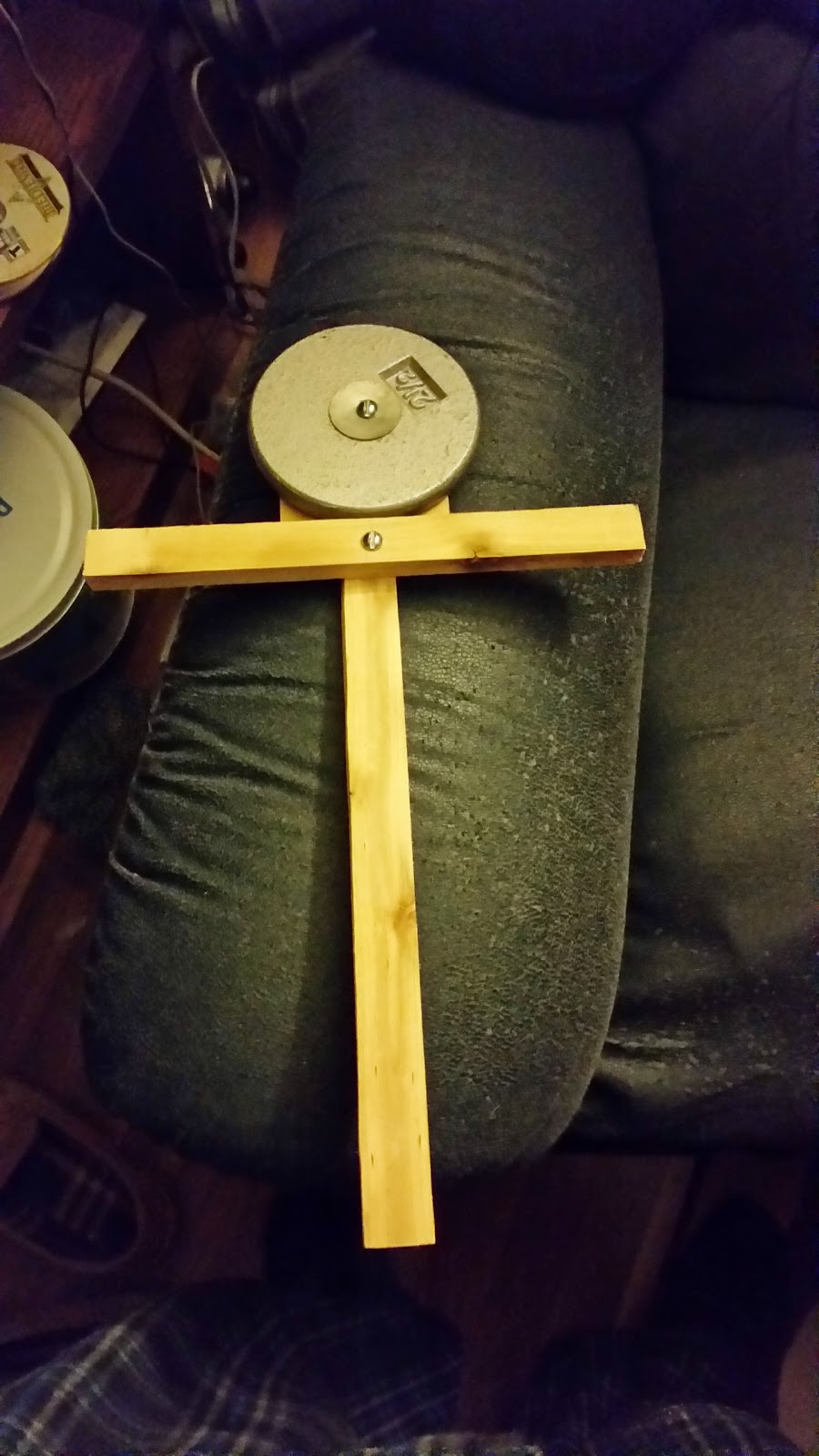
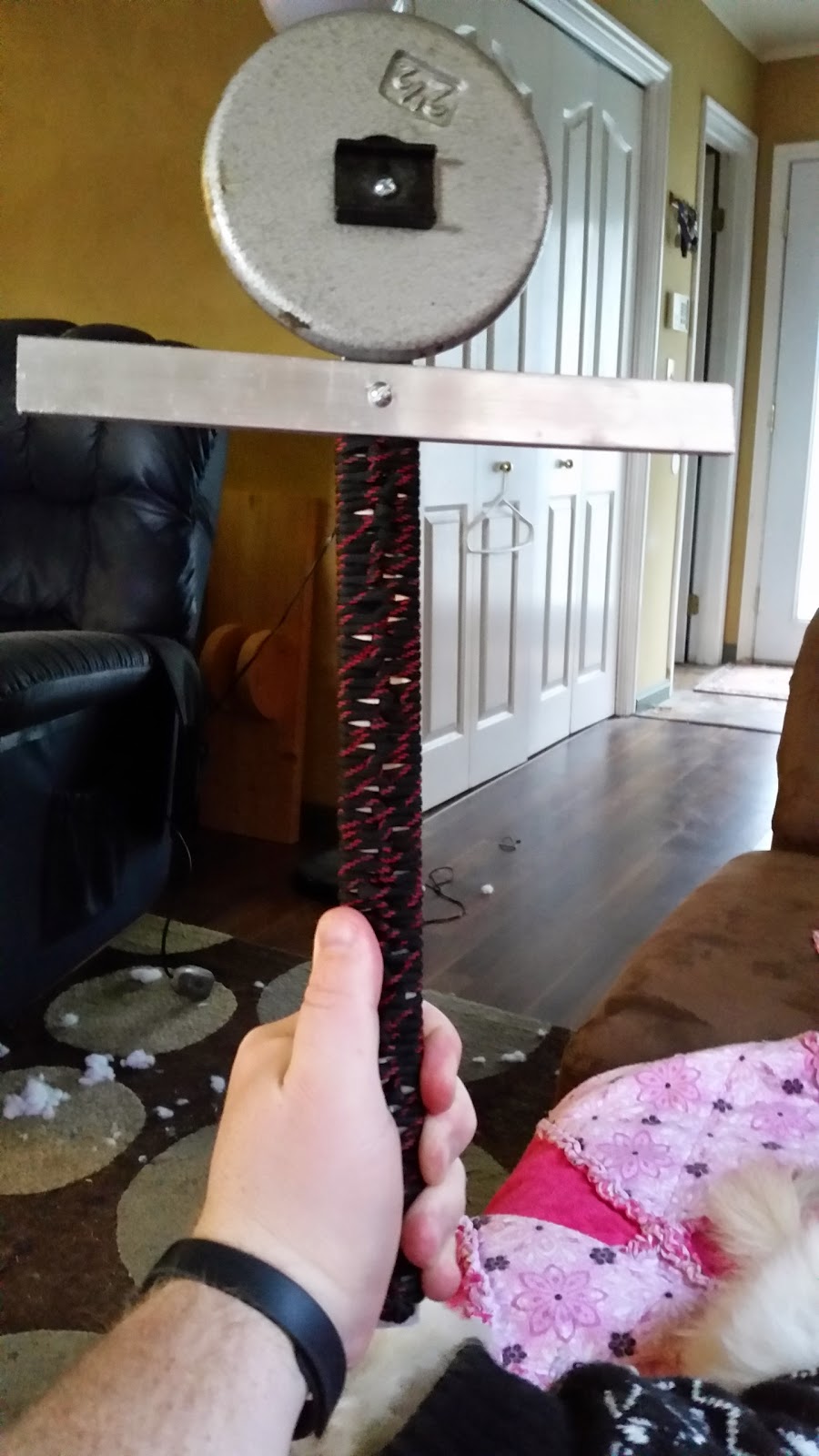 That is where my sword trainer tool comes in handy. I dedicated to this thing and dammit, I am going to hit the 30 days without skipping a day. What this little training tool lets me do is practice my cuts inside, in my living room without hitting furniture, ceilings, or breaking light fixtures. The length of the handle is as long as my Feder, and the cross guard is the length of the cross guard, so if I do something I shouldn't be able to with a sword I get hit with it. Also the length of the guard means that I can cut down then use my hands like I should to bring the weight up unlike doing practices with a dumbbell. The first one was wood, the second one aluminum and I couldn't be happier with it.
The balance is a bit forward but not as bad as it could be. The weight is changeable so right now I am training with 2.5 pounds but it is easy enough to train with 3 or add a weight on the other side and double the weight. It has been an awesome tool to train with for a half hour on Fridays when I have nothing else going on, or on days when I have something that keeps me from the other classes or exercises that I normally do. The cool part about it is that the cost was minimal to make it. (I had all the parts laying around) and after 50 cuts I can feel it working. I even have one in the works for my friend who wanted a short sword one, and for 10 bucks without the weight can easily make one for him.
What I am really driving at here is that if you want something and are willing to put the time energy and effort in, you can get there. I am still a long ways from my weight goal but the thing is that this time it does not matter. The numbers on the scale do not mean I am not a fast swimmer, or that I cannot hold my own against enough of the people I fence with that I feel like I am super far behind. I am helping drive the conversation, and I am training myself in little ways that will, when I am done, make me better at what I do.
Fridays could have been the off day. They could have been the day that I did nothing but watch TV and ate chips. Instead they are the light, 30 minute of cutting drills day. The day that I get my 30 in and then do whatever else I need to.
Nutrition has changed too. My wife is a partner in this, we are eating much more fruit and less carbohydrates not because they are evil but just as a way of eating better. Last week I lost 6 pounds, this week my weight went back up by 1 but I am not worried. This is not a short term fix to long term problems. You want to know the super secret way to loose 30 pounds? 100? Keep on it, change your life, it is not in a pill, a wrap, or some magic exercise routine that you follow for 30 days. It is in making the change from grabbing a candy bar to grabbing an apple on the way out the door. I am down a few pounds so far, but I feel better, and training a little each day helps that. Weighing the cost of eating 250 calories of candy bar when it means I have to work out for a half hour or more to burn it off means it is just not worth it.
This is a journey. After 30 days starts my longer challenge. Maybe I am only 15 in it now, but if I can keep it going after this month I cannot imagine the rewards being anything less than good.
Every journey starts where your feet are and ends, where you take yourself. I am glad I have begun this one and it is getting me where it is.
January 2nd I began the 30 in 30 HEMA challenge, 30 days, at least 30 minutes of exercise each day. Today marks day 15.
How has it worked? In December we started taking classes at the gym. A water aerobics class that is doing a fair job at kicking my ass because I am pushing myself. 4 days a week, one hour classes a day. Then came adding another Long sword class to my normal training. There is another group in town that meets at the University on Tuesday nights, which happens to be one of the dead nights in my schedule. Thursdays is Olympic Fencing, which as of last week I am helping coach. And In addition to the water class on Saturdays I have my normal sword class. But what about Fridays? The one night a week that I have nothing on the schedule?
That is where my sword trainer tool comes in handy. I dedicated to this thing and dammit, I am going to hit the 30 days without skipping a day. What this little training tool lets me do is practice my cuts inside, in my living room without hitting furniture, ceilings, or breaking light fixtures. The length of the handle is as long as my Feder, and the cross guard is the length of the cross guard, so if I do something I shouldn't be able to with a sword I get hit with it. Also the length of the guard means that I can cut down then use my hands like I should to bring the weight up unlike doing practices with a dumbbell. The first one was wood, the second one aluminum and I couldn't be happier with it.The balance is a bit forward but not as bad as it could be. The weight is changeable so right now I am training with 2.5 pounds but it is easy enough to train with 3 or add a weight on the other side and double the weight. It has been an awesome tool to train with for a half hour on Fridays when I have nothing else going on, or on days when I have something that keeps me from the other classes or exercises that I normally do. The cool part about it is that the cost was minimal to make it. (I had all the parts laying around) and after 50 cuts I can feel it working. I even have one in the works for my friend who wanted a short sword one, and for 10 bucks without the weight can easily make one for him.
What I am really driving at here is that if you want something and are willing to put the time energy and effort in, you can get there. I am still a long ways from my weight goal but the thing is that this time it does not matter. The numbers on the scale do not mean I am not a fast swimmer, or that I cannot hold my own against enough of the people I fence with that I feel like I am super far behind. I am helping drive the conversation, and I am training myself in little ways that will, when I am done, make me better at what I do.
Fridays could have been the off day. They could have been the day that I did nothing but watch TV and ate chips. Instead they are the light, 30 minute of cutting drills day. The day that I get my 30 in and then do whatever else I need to.
Nutrition has changed too. My wife is a partner in this, we are eating much more fruit and less carbohydrates not because they are evil but just as a way of eating better. Last week I lost 6 pounds, this week my weight went back up by 1 but I am not worried. This is not a short term fix to long term problems. You want to know the super secret way to loose 30 pounds? 100? Keep on it, change your life, it is not in a pill, a wrap, or some magic exercise routine that you follow for 30 days. It is in making the change from grabbing a candy bar to grabbing an apple on the way out the door. I am down a few pounds so far, but I feel better, and training a little each day helps that. Weighing the cost of eating 250 calories of candy bar when it means I have to work out for a half hour or more to burn it off means it is just not worth it.
This is a journey. After 30 days starts my longer challenge. Maybe I am only 15 in it now, but if I can keep it going after this month I cannot imagine the rewards being anything less than good.
Every journey starts where your feet are and ends, where you take yourself. I am glad I have begun this one and it is getting me where it is.
Wednesday, December 31, 2014
A time to every purpose.
"To every thing there is a season, and a time to every purpose under the heaven."
This morning I awoke earlier than normal. For years waking up early on New Years Eve was something I did as we held an annual World Healing Meditation at my church. It is not something that they do anymore, and since my absence from church it is hardly something I can suggest as a tradition to bring back so this morning I did at home.
There is a lot to be said about tradition. Many times we do them, simply because that is how they are done. One such example is new years resolutions. I wrote on mine some last week, but this morning something else happened from within me. I realized that to take steps forward in my life it was important that I turn within evaluate what is working and what is not, and then create a mantra or mission statement or something as a focus for the new year.
Do not get me wrong, 2014 was spectacular. I learned things I never knew, met lots of new people had some great experiences. I think that is the crux though. We look at a new year and seem to have to think badly about the one that just past, as if somehow talking it down makes the next one that much better; it doesn't.
In November at the Moab Celtic Festival when doing heavy athletics I broke a caber. To me it was upsetting. I was told later that it happened, but to me it was not something to be proud of, I was embarrassed and felt terrible about it. Upon looking back at it more closely, I have realized something. That broken caber, was and still is a lesson.
Why had it broken? Was there some sort of internal flaw like a knot that meant it was going to break? No. This was a solid piece that had broken because my form and technique was not good, because I had the misconception that by strength alone I could turn this Caber, even if my technique was not right. In that I was wrong.
To me, that meant a bigger lesson. Often times in my life I have gotten through by sheer force of will. As if pushing harder was the way through everything. I am a reasonably strong guy (Less so than most anyone I to Scottish games with, but that is another post entirely) and often times I know I can use my size, or in some cases my wits to get through problems without doing what is called for to do it right and well. That did not work that day. I could not push through it and come out the winner through sheer force of will.
So what is the goal for 2015? Knowing what is right and when and taking the right steps to do what is needed. It means less filling time with things like browsing Facebook when I am waiting for an elevator. It means spending more time devoted to doing things that bring me joy, and less time filling time up with something, anything that may fill the time so I am not alone with my thoughts and ideas.
This year is about finding the right times for every purpose in my life, and having the wisdom to do what is needed at that time to make it work out the best it can be. To be clear, and honest about what is going on, and to take the right steps to be where I need to be. This year is about trusting that if I follow the things that bring me joy, life will just be better. Knowing what tools I have in my toolbox and using them right, so that at the end of the day I can rest in knowing that I did what I needed to and did it well.
2014 was great, and I look forward to 2015, may it bring us all the things we are seeking.
This morning I awoke earlier than normal. For years waking up early on New Years Eve was something I did as we held an annual World Healing Meditation at my church. It is not something that they do anymore, and since my absence from church it is hardly something I can suggest as a tradition to bring back so this morning I did at home.
There is a lot to be said about tradition. Many times we do them, simply because that is how they are done. One such example is new years resolutions. I wrote on mine some last week, but this morning something else happened from within me. I realized that to take steps forward in my life it was important that I turn within evaluate what is working and what is not, and then create a mantra or mission statement or something as a focus for the new year.
Do not get me wrong, 2014 was spectacular. I learned things I never knew, met lots of new people had some great experiences. I think that is the crux though. We look at a new year and seem to have to think badly about the one that just past, as if somehow talking it down makes the next one that much better; it doesn't.
In November at the Moab Celtic Festival when doing heavy athletics I broke a caber. To me it was upsetting. I was told later that it happened, but to me it was not something to be proud of, I was embarrassed and felt terrible about it. Upon looking back at it more closely, I have realized something. That broken caber, was and still is a lesson.
Why had it broken? Was there some sort of internal flaw like a knot that meant it was going to break? No. This was a solid piece that had broken because my form and technique was not good, because I had the misconception that by strength alone I could turn this Caber, even if my technique was not right. In that I was wrong.
To me, that meant a bigger lesson. Often times in my life I have gotten through by sheer force of will. As if pushing harder was the way through everything. I am a reasonably strong guy (Less so than most anyone I to Scottish games with, but that is another post entirely) and often times I know I can use my size, or in some cases my wits to get through problems without doing what is called for to do it right and well. That did not work that day. I could not push through it and come out the winner through sheer force of will.
So what is the goal for 2015? Knowing what is right and when and taking the right steps to do what is needed. It means less filling time with things like browsing Facebook when I am waiting for an elevator. It means spending more time devoted to doing things that bring me joy, and less time filling time up with something, anything that may fill the time so I am not alone with my thoughts and ideas.
This year is about finding the right times for every purpose in my life, and having the wisdom to do what is needed at that time to make it work out the best it can be. To be clear, and honest about what is going on, and to take the right steps to be where I need to be. This year is about trusting that if I follow the things that bring me joy, life will just be better. Knowing what tools I have in my toolbox and using them right, so that at the end of the day I can rest in knowing that I did what I needed to and did it well.
2014 was great, and I look forward to 2015, may it bring us all the things we are seeking.
Subscribe to:
Posts (Atom)